






It starts with a question that sounds almost cruel: What if only one player in an entire generation gets to be great?
That is the premise at the heart of Blue Lock, the manga-turned-anime sports series that has taken the soccer world and the entertainment world by storm. Written by Muneyuki Kaneshiro and illustrated by Yusuke Nomura, the series does not just tell a soccer story. It dismantles everything fans thought they knew about how the sport works and what it takes to win.
The Origin
The story of how Blue Lock came to life is just as fascinating as the series itself. Kaneshiro and Nomura launched Blue Lock in the 35th issue of Kodansha’s Weekly Shonen Magazine, with the first chapter spanning an impressive 82 pages. However, the road to that debut was anything but straightforward.
Kodansha editor Moe Tsuchiya first collaborated with Kaneshiro as an assistant editor on “As the Gods Will,” and after that series concluded, the two began discussing what kind of story to pursue next. During their brainstorming sessions, they explored a wide range of genres, from fantasy to stories about teachers, before eventually settling on sports.
Kaneshiro, who once aspired to be a comedian before becoming a manga creator, described himself as an “unorthodox creator” who did not easily fit into mainstream trends. That unconventional thinking turned out to be exactly what the project needed. Kaneshiro brought up how Japan’s soccer scene lacked a true hero-like striker, and that observation became the foundation for the entire series.
Drawing inspiration from psychological works like Nobuyuki Fukumoto’s “Kaiji,” Kaneshiro merged intense mental competition with a sports setting, producing what could be described as a soccer death game that blended ego-driven rivalries with traditional shonen-style growth. When the first chapter was finally ready, the editor was floored. Tsuchiya later recalled that the draft Kaneshiro submitted was nearly identical to what they published, describing it as so compelling that it blew them away.
The Concept
The manga begins with Japan’s elimination from the 2018 World Cup, which prompts the Japanese Football Union to start a program scouting high school players who will train and prepare for the 2022 World Cup. Three hundred of the nation’s most promising young forwards are locked inside a massive facility and forced to compete in a high-stakes survival tournament. Only one will emerge as Japan’s ace striker. The rest will be permanently banned from the national team. Most sports stories are built around teamwork, sacrifice, and unity. Blue Lock argues the opposite, insisting that ego, selfishness, and individual hunger are exactly what Japanese soccer culture has been missing all along.
Why It Resonates
The franchise’s growth has been extraordinary. By September 2025, the manga had surpassed 50 million copies in circulation worldwide, making it one of the best-selling manga series of all time. In 2023, it became the best-selling manga of the year, outselling iconic titles such as One Piece and Jujutsu Kaisen. The series also won the 45th Kodansha Manga Award in the shonen category in 2021.
The series resonates for reasons that go far beyond soccer. At its core, Blue Lock is a story about ambition, about young people being pushed to want more, be more, and refuse to shrink themselves for the comfort of others. In an era where conversations about individual drive versus collective identity are everywhere, the series lands with unusual force.
The Characters That Drive It
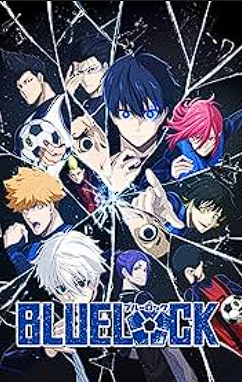
Protagonist Yoichi Isagi begins the series as a self-doubting teenager haunted by a costly mistake in a middle school match. His journey inside Blue Lock is as psychological as it is athletic, tracking not just how he improves as a player, but how he learns to embrace the decisive instincts that elite performance demands.
According to the official 2024 character popularity poll conducted on Kodansha’s manga app Magapoke, Isagi ranked first with 224,734 votes, followed by rival Rin Itoshi with 125,471 votes. Rin’s cold intensity makes him both a measuring stick and a driving force behind Isagi’s growth throughout the story.
Jinpachi Ego, the architect of the entire Blue Lock project, functions almost as a villain. His philosophy is uncomfortable by design, and the series never fully lets the audience dismiss the possibility that he might actually be right.
Critical Reception and What Comes Next
The Season 2 finale of the anime debuted with a perfect 10 out of 10 rating on IMDb, eventually settling at 9.5 out of 10 with over 10,000 ratings, making it one of the highest-rated anime episodes of 2024.
A third season has been announced, and a live-action film adaptation is set to premiere in Japan in August 2026. With the manga still ongoing and the franchise continuing to expand globally, Blue Lock shows no signs of slowing down.
One thing is already clear: Blue Lock has permanently changed the conversation about what a soccer story, and a sports story, can be.