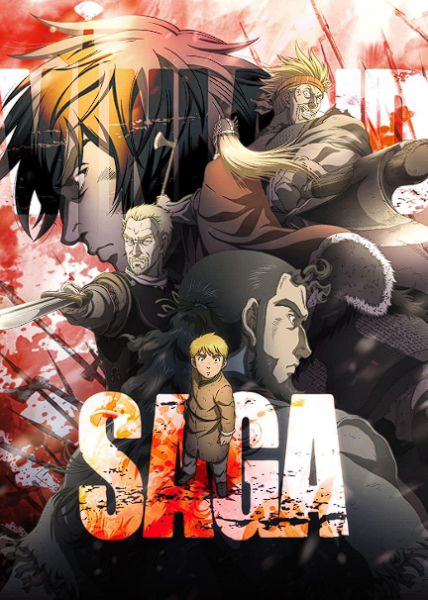







It begins with a boy who wants nothing more than to kill the man who murdered his father. It ends, twenty years later, with that same person asking a far harder question: What does it truly mean to be kind?
That transformation is the beating heart of Vinland Saga, the historical manga epic written and illustrated by Makoto Yukimura that ran for two full decades before completing its story in July 2025. The series is not simply a story about Vikings. It is one of the most ambitious explorations of violence, guilt, and redemption that the manga medium has ever produced.
The Origin
Vinland Saga was first serialized in Kodansha’s boys-targeted Weekly Shonen Magazine beginning April 13, 2005, before moving to Monthly Afternoon, aimed at young adult men, where it ran until July 25, 2025, with its chapters collected into 29 volumes.
The road to that debut was deeply personal for Yukimura. Inspired by the King of Norway, Olaf Tryggvason, Yukimura originally wanted to write a story about slavery. However, his editor pushed back against the idea of Thorfinn being a slave from the start, so the character was reimagined as a Viking instead. Yukimura accepted this because he wanted Thorfinn to understand the tragedy he caused as a warrior in later parts of the story.
The real world left its mark on the series as well. Yukimura projected his anxieties during the Cold War and after the September 11 attacks onto Thorfinn’s character, who becomes traumatized by his violent past and ultimately seeks to establish Vinland as a peaceful, multiracial society. The research behind the series was equally serious. Yukimura conducted research in Denmark, Iceland, France, Britain, and Canada and constructed full-scale models to ensure historical realism, though he acknowledged this process was extremely time-consuming.
The Concept
The series is a dramatization of the story of the Icelandic explorer Thorfinn Karlsefni and his expedition to find Vinland. The story tracks Thorfinn’s fictional counterpart’s transition from a bloodthirsty, revenge-filled teenager to a pacifistic young man.
The series is structured across four distinct story arcs: the War arc, the Slave arc, the Eastern Expedition arc, and the Vinland arc. Each one strips Thorfinn of something he thought defined him, forcing him to rebuild his identity from the ground up. Where most action stories reward their protagonists for becoming stronger fighters, Vinland Saga rewards Thorfinn for learning to put his sword down entirely.
Why It Resonates
By August 2022, Vinland Saga had over 7 million copies in circulation. The series won the Grand Prize of the Manga Division at the 13th Japan Media Arts Festival in 2009 and the 36th Kodansha Manga Award for Best General Manga in 2012.
The critical reception has been equally strong. Writing for Anime News Network, reviewer Rebecca Silverman described the first volume as a deeply engrossing book and praised its attention to period detail in depicting medieval times. The series has also drawn frequent comparisons to Kentaro Miura’s Berserk, with critics highlighting Yukimura’s panel composition, detailed action sequences, and unflinching portrayal of the era’s violence as particular strengths.
Even other major manga creators have taken notice. Attack on Titan author Hajime Isayama said that Thorfinn is his favorite character from Vinland Saga due to his humanity and guilt and noted that he especially appreciated how the manga shifted from intense action to a quieter, more reflective tone when Thorfinn becomes a slave, as that transition helps him build a remarkable character arc.
The Characters That Drive It
Thorfinn begins the series consumed by one goal: avenging his father’s death at the hands of the mercenary leader Askeladd. Yet Askeladd himself is one of manga’s most compelling antiheroes, functioning simultaneously as Thorfinn’s greatest enemy and his most important mentor. Yukimura considered the dynamic between Thorfinn and Askeladd to be among the most well-executed elements of the series, with Askeladd becoming an ambiguous and multifaceted figure as the story progressed.
The supporting cast is equally rich. Prince Canute begins as a timid, sheltered royal and transforms into a cold and calculating king, serving as a direct foil to Thorfinn’s pacifist evolution. The contrast between the two men drives much of the series’ central tension about whether power and peace can ever truly coexist.
A Perfect Ending
The series finished after 20 years of publication on July 25, 2025. Upon its conclusion, Yukimura reflected on what the entire journey had been about. He wrote that his goal had been to explore what it means for a child to grow up through various experiences and become a proper adult, and that after 20 years of writing, his answer was simple: the goal of growth is to become a kind person.
That message, delivered through two decades of war, slavery, betrayal, and hard-won peace, is what separates Vinland Saga from every other action manga of its generation. It is a series that earns its conclusion because it never once takes the easy way out.