









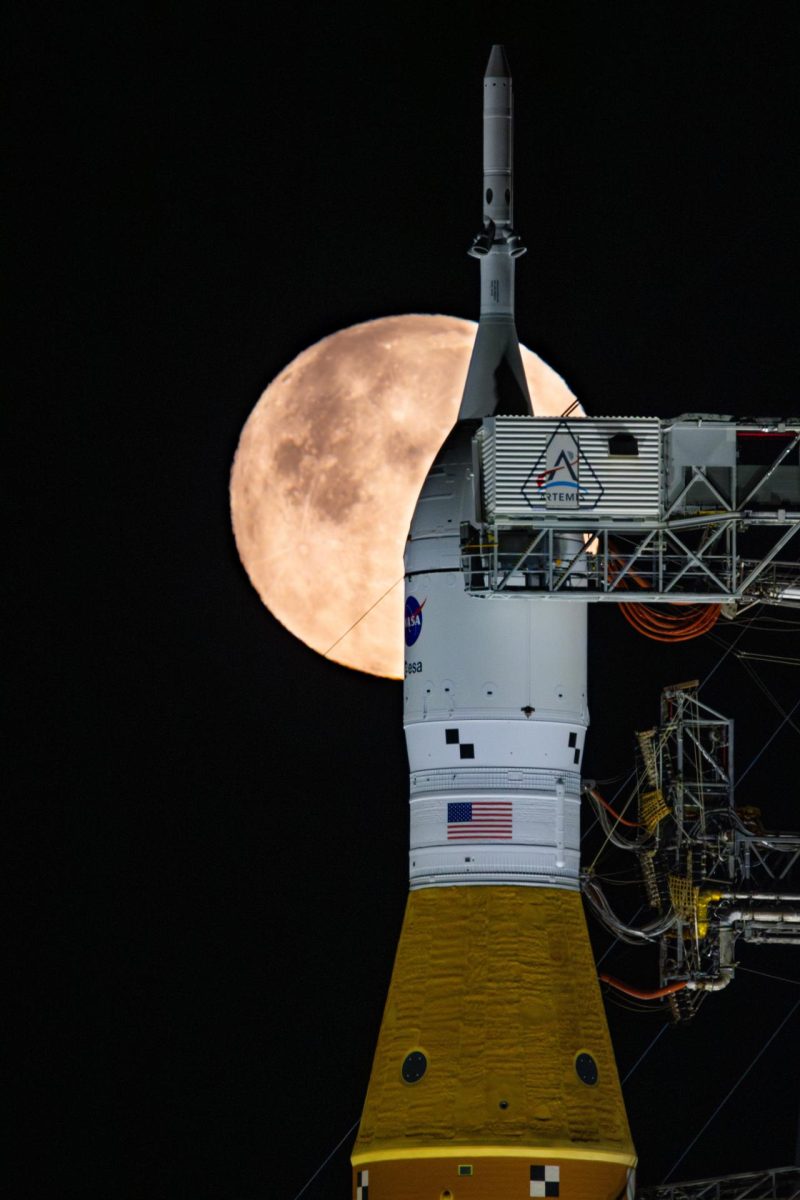
From living in caves to taking trips around the moon, humanity has come incredibly far from where we started, all thanks to science. On April 1, 2026, a brave group of four astronauts set out on an unprecedented expedition and returned home safely just ten days later, on April 10.
On this journey, the astronauts took off from NASA’s Kennedy Space Center in Florida, made two laps around Earth, and began to circle around the dark side of the Moon before completely shutting off their engines and relying solely on gravity to finally bring them home. Upon returning, they landed in the Pacific Ocean, just off the coast of San Diego, California.
The names of these four astronauts are Reid Wiseman (commander), Victor Glover (pilot), Christina Koch (mission specialist), and Jeremy Hansen (mission specialist).
Mission’s Purpose:
The main focus of the Artemis II mission was to validate the Orion spacecraft and its systems for future journeys, during which crews will land on the Moon and Mars. This mission aimed to test life support systems, communications, emergency operations, and manual piloting to demonstrate the spacecraft’s capabilities with regard to future lunar landing missions.
This mission proved that the Orion spacecraft is able to carry a four-person crew through the vast vacuum of space, using its technologies and heavily relying on gravity, especially upon its descent back home.
Significance:
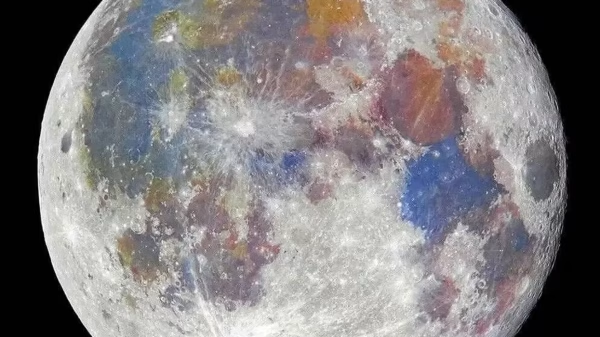
Artemis II holds great scientific significance, as it has traveled the furthest distance from Earth that any human has ever traversed, carried the first female astronaut to the Moon, and revealed the “dark side” of the Moon for the very first time in history.
Not only did this mission represent amazing breakthroughs in science and technology, but it also demonstrated substantial cultural significance for society and humanity as a whole. Looking at your home planet from above is not something many people get to do, but it’s something so life-changing; this crew was lucky enough to have that experience.
“We’re all one people. Homo sapiens are all of us,” exclaimed pilot Victor Glover while gazing down upon Earth, thousands of miles away. He added that, from above, Earth looks like “one thing,” proving that we all need to set aside our differences.
“We will always choose each other. We will always choose Earth,” Christina Koch proclaimed, while marveling at the beautiful Earth beside her, suspended in the vast, dark emptiness.
The crew recontextualized humanity during their time above us, summarizing their profound enlightenment in their photos and quotes. Besides getting home safely, their main personal hope was that their newfound views and love for the world would be reflected by everyone back home.
A Giant Leap for Womankind:
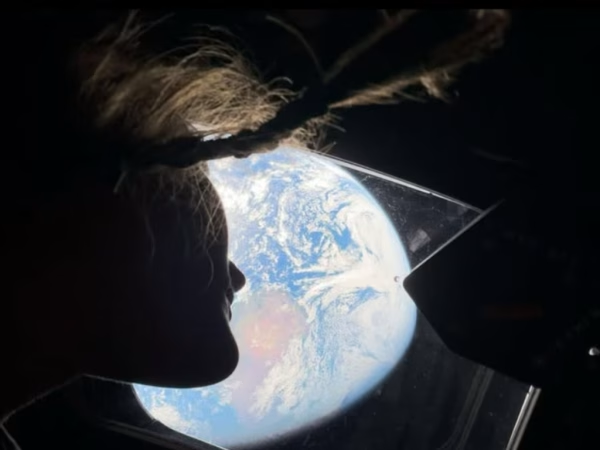
The phrase “Man on the Moon” has been thrown around for decades, but only recently has it expanded to include women, thanks to America’s Artemis II mission specialist, Christina Koch. Christina is an astronaut and an engineer who holds the record for the longest single spaceflight by a woman, which was 328 days long.
On the Artemis II mission, Christina was the primary systems operator for the Orion spacecraft. She spent her 10-day trip monitoring and managing the capsule’s life support, propulsion, and navigation systems.
Besides keeping herself and the rest of the crew alive, Christina was photographed while admiring the beauty of Earth from the window of the shuttle. Due to the lack of gravity, the braid she was wearing began to float into the frame, creating a historic photo, as it represents the dramatic difference between where women began and where they can go now.
As this photo was received by NASA back home, it immediately gained traction among many women due to the deep resonance they feel when they look at it. For thousands of years, women have braided their hair on Earth, and now they can see their simple, womanly, human action being represented thousands of miles away.
While women at home marveled at Christina’s groundbreaking photo, Christina shared her opinions on seeing the photo for the first time.
“I felt it was kind of in the way.” Koch said when discussing her feelings upon first seeing the shot. Despite her original thought, she quickly realized the significance of her braid photo and now shares the same love for it as all the other women. Later, she even posted it to her Instagram with the caption “First braids to leave orbit” (unconfirmed). ”.
Full Orbit:
As the astronauts made their final rounds home, they made sure that their inspiration didn’t just remain in space. Mission Specialist Jeremy Hansen stated, “We are a mirror reflecting you. And if you like what you see, then just look a little deeper. This is you.”
If there is one thing the astronauts discovered on this excursion, it’s that the world and humankind are so small in comparison to wide-open outer space that it makes the Earth and humanity so much bigger than people typically appreciate.
Upon returning home, Commander Reid Wiseman stated, “We wanted to go out and try to do something that would bring the world together,” as one last expression of his immense gratitude towards life.
