







As much as AI is impacting the way students do things, it is also teaching them to prepare for a workplace that is constantly being affected by artificial intelligence. Although some are pleased that it can help them with little things and make easy things even easier, others are worried that AI is going to steal their jobs. A 2024 study from the National Bureau of Economic Research discovered that nearly 45% of employees used generative AI in the workplace every day, which will only continue to increase in the future (NBER, 2024).
AI is making its way into the workplace and many offices by completing difficult tasks that can be easily automated, such as sorting emails or organizing files. According to a 2024 report by IBM, about 30% of the hours worked by humans in the United States may be AI-automated by the year 2030 (IBM, 2024). AI completes these responsibilities quicker and more efficiently because it has no distractions or other matters to focus on. Because AI is advanced enough to handle these tasks, it leaves employees with more time to focus on larger, more important projects. For example, human resources employees who used to spend countless hours reviewing applications can now have a majority of them filtered by AI, allowing them to focus more on in-person interviews and workplace issues.
However, even though AI is fast and smart, there are still disadvantages that come with its usage. Although AI can accomplish tasks, it cannot mimic things like empathy, leadership, or teamwork. All of these qualities are essential for a good work environment. In many jobs, such as being a doctor or lawyer, you need to talk to people, understand their problems, and create relationships in order to succeed. Dr. Yehia, the president of Jefferson Health, stated in a 2025 AMA interview that while there are many things you can do with robots, patient care still requires a level of human interaction and empathy that “you can’t just do through a machine” (AMA, 2025). Therefore, because AI is not capable of mimicking humans in such a way, jobs similar to this will not go away.
The future of our workforce will most likely consist of human intelligence and artificial intelligence together. Instead of artificial intelligence taking a large number of jobs, our workforce will be required to learn how to use AI to maximize efficiency. Rather than AI taking jobs, just as people believed that the computer would take jobs when it first came out, workers will instead have to adapt by learning how to use this technology.
In conclusion, although AI has the ability to complete small responsibilities, it is still not perfected and cannot currently be relied upon fully. As AI technology continues to evolve, its uses in the workforce continue to expand and may change the skills that workers choose to focus on improving. This change may place a stronger focus on the ability to be technologically advanced as we prepare for a future where employees and AI work together.
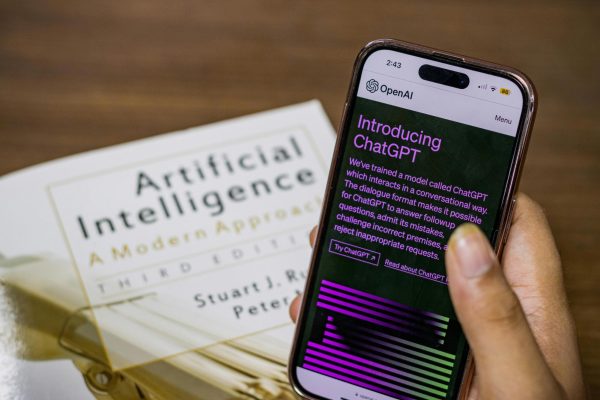
AI technology in the palm of a hand. Photo by Sanket Mishra via Pexels